
Message Sent






Fintech software development: from MVP to production without a rewrite
Why fintech products don't break under traffic but under compliance, fraud and money movement, and what to decide early to scale from MVP to production without rewriting everything.

Most fintech products don't break when the traffic arrives. They break much earlier: the moment the MVP built to prove an idea runs into what makes fintech different from any other software, namely compliance, fraud and the movement of real money. A B2C fintech we took from prototyping to production came to us with a product that worked beautifully in demos. Within two months it was live and handling real users: not because we wrote code faster, but because we decided right away what was "throwaway" and what had to be production-grade from the very first line.
This article is for anyone who already has a fintech product or is building one: founders who need to move from PoC to a real product, scale-ups growing faster than their architecture, companies already in fintech that want to launch a new vertical. We'll look at four points where decisions get expensive: product strategy (which in fintech is first of all a decision about what's regulated), AI integration and where it's really needed, a UX that builds trust instead of chasing the wow factor, and infrastructure designed for audits and continuity, not just for peaks.
One figure to keep in mind: according to CB Insights, the leading root cause of startup failure isn't the code, but building something the market doesn't want, in 43% of the cases analyzed. In fintech, a second risk adds to that one, just as lethal: building something the regulator won't let you operate.
Anyone building a fintech MVP lives with a specific tension: you have to move fast to validate and get to market first, but you can't afford to get other people's money wrong. It's the difference between the MVP of a social app and an MVP that moves payments: in the first case a slow screen is annoying; in the second it costs money and wipes out trust in an instant.
The point we see underestimated most often is that scaling in fintech isn't a server problem. It's a problem of re-architecting around three things that only become real when you have real users: compliance, data integrity and trust. The architecture that gets you to your first 10,000 users is rarely the one that can handle a million, and in fintech the wall isn't computing power: it's the first serious audit or the first wave of fraud attempts.
Our position, as people who take these products to production, is simple: in fintech you don't buy speed by cutting corners, you buy it by deciding in advance where you can't cut them. The fintech companies that go to production fast and stay there aren't the ones that wrote the least code. They're the ones that separated the regulated, critical path (onboarding, KYC, money movement) from everything else early on, building the first as a real product and the second as a hypothesis ready to be thrown away.
Product strategy: first decide what's regulated, then what's cool
The compliance boundary is an architecture choice, not a chapter for legal
In fintech, product strategy starts from a different question than usual. Not "which features do we need?", but which functionality of this product touches money, identity or financial data, and is therefore regulated. That part defines the boundaries of the architecture before the first mockup even exists. Anyone who treats compliance as a chapter to add later ends up rewriting the core of the product when they find out that the license they need isn't compatible with how they built things.
- Map the regulated flow first. Onboarding, identity verification (KYC), anti-money laundering (AML) and money movement are the core that has to be production-grade from the start. Everything else can stay MVP.
- Separate what's core from what's a hypothesis. You build the regulated must-keep well, once; you build the nice-to-have already knowing it may be thrown away after the test.
- Draw your vendor boundaries deliberately. Payment rails, KYC providers, banking APIs: every external integration is a dependency with its own latency and its own failure points, and it should be chosen with scale already in mind, not just the MVP.
- Define KPIs that measure trust, not just growth. Onboarding completion rate, fraud-detection false positives, time to resolve a dispute: in fintech they matter as much as user numbers.
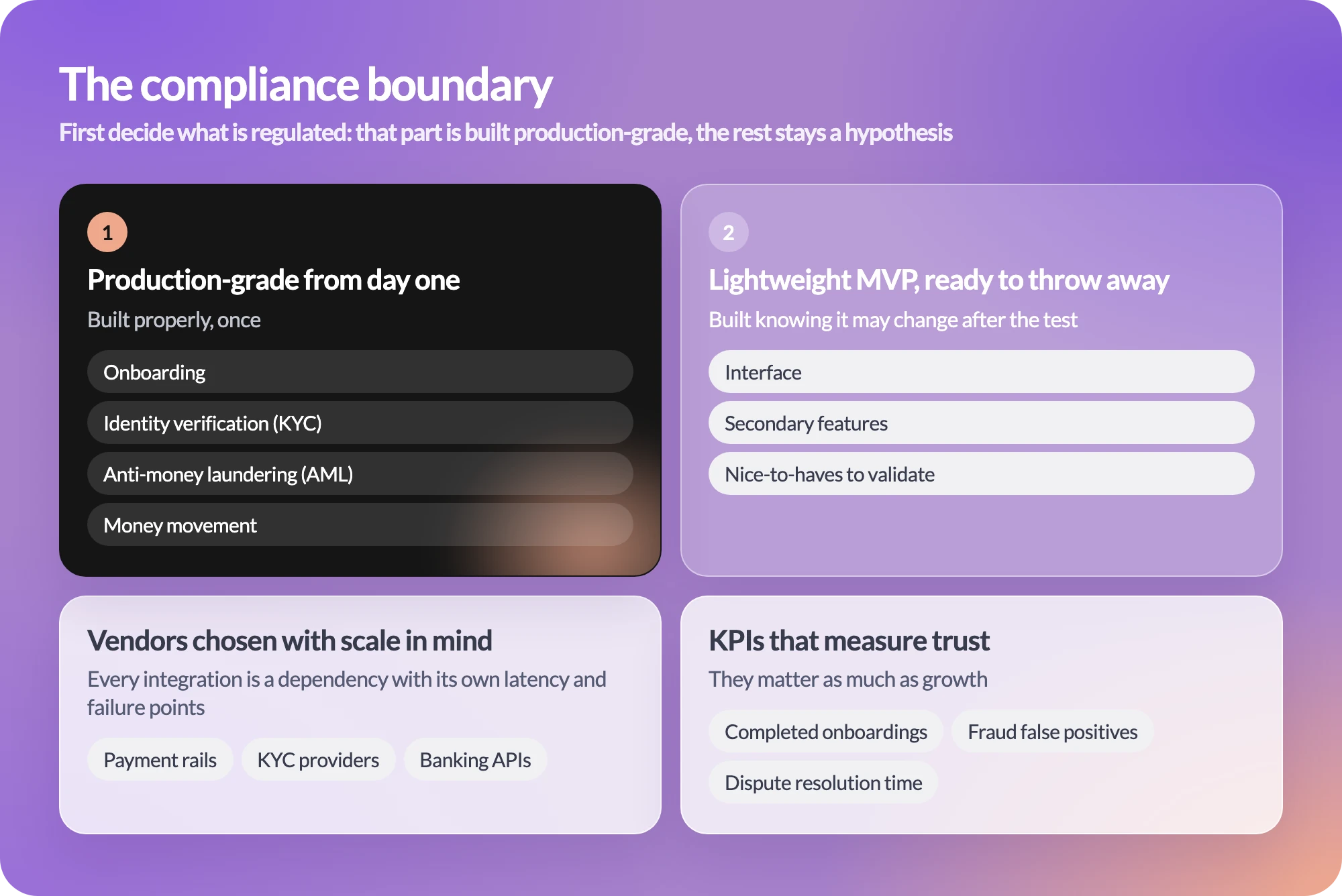

On the consumer fintech project we started from, this separation is exactly what made the difference between two months of implementation and six: onboarding and money movements were treated as the final product from day one, while the interface and secondary features were deliberately kept light, to be revisited after the first real data came in.
Integrate AI where it reduces risk and creates value, not where it looks good
AI-Powered When It Matters isn't a slogan, it's a selection criterion
There's a strong temptation in fintech: put AI everywhere because it looks innovative. The result is almost always a chatbot nobody uses and a cost nobody can justify. Our rule is more boring, but also more useful: AI earns its place in a fintech product when it reduces a risk or an operating cost on the path that matters. BCG, in its report with QED Investors, puts it in its own way: fintech has moved from growth at all costs to a phase where avoiding adding risk to the system is worth as much as generating margins. That, we'd say, is exactly where AI becomes valuable.
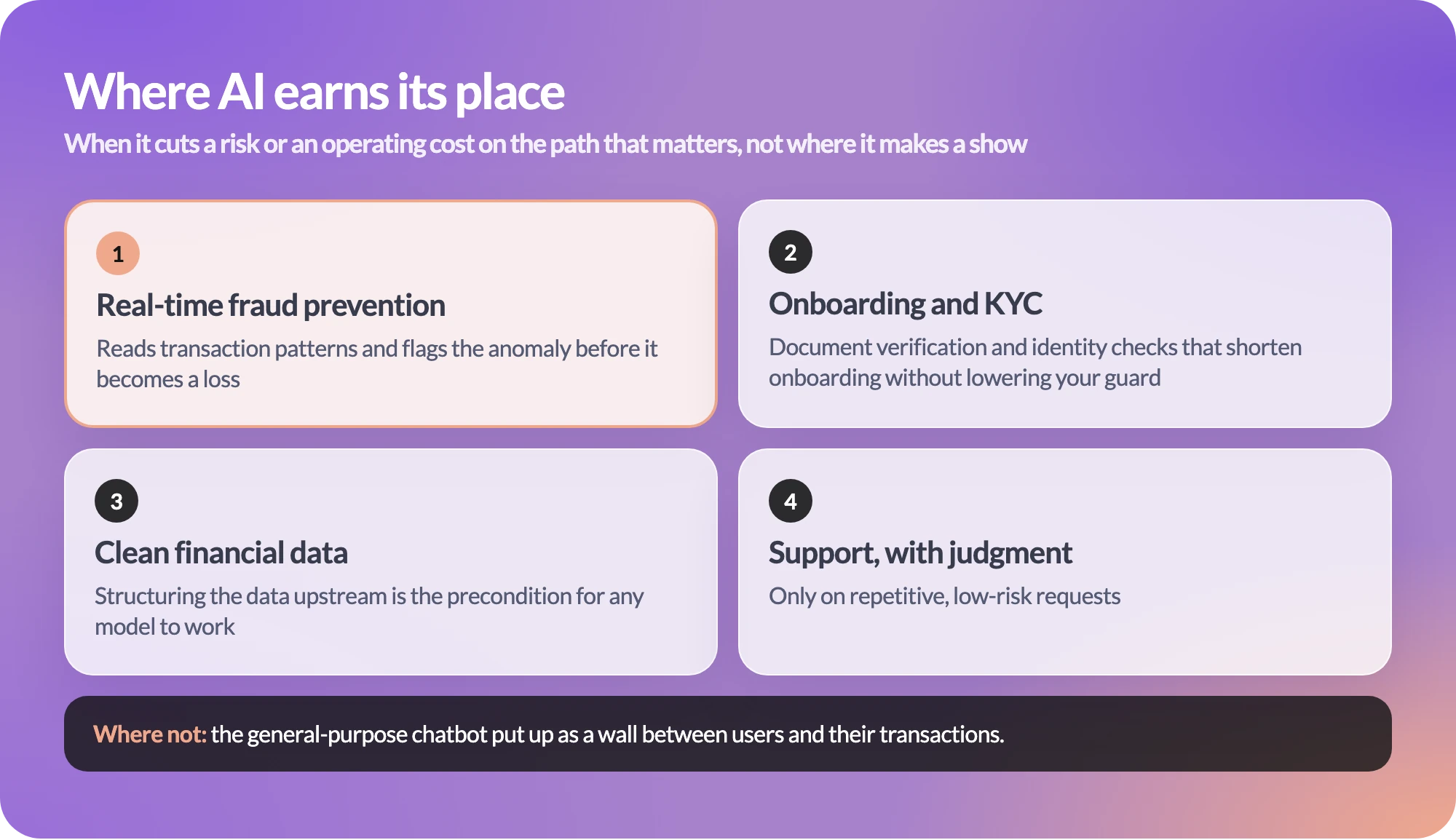
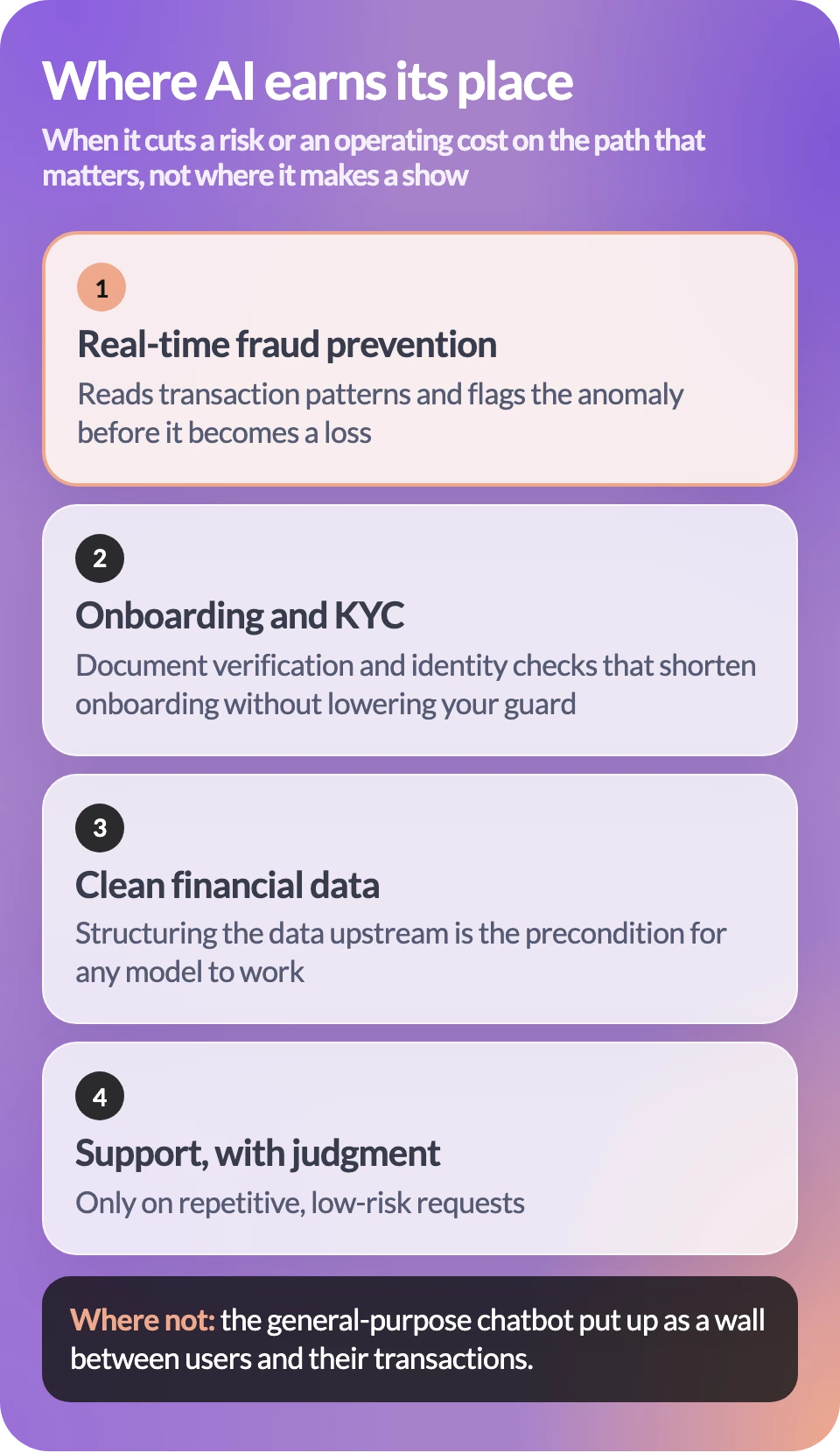
- Real-time fraud prevention. Models that read transaction patterns and flag the anomaly before it becomes a loss. Here AI saves real money.
- Onboarding and KYC. Automated document verification and identity checks that shorten onboarding without lowering your guard on compliance.
- Financial data management. Many fintechs inherit dirty data and inconsistent formats from legacy systems. Cleaning and structuring the data upstream is the precondition for any AI model to work, not the other way around.
- Support, but with judgment. A conversational assistant makes sense for repetitive, low-risk requests, not as a wall between users and their transactions.
UX in fintech: the interface's job is to build trust
The right friction, in the right place, is a feature
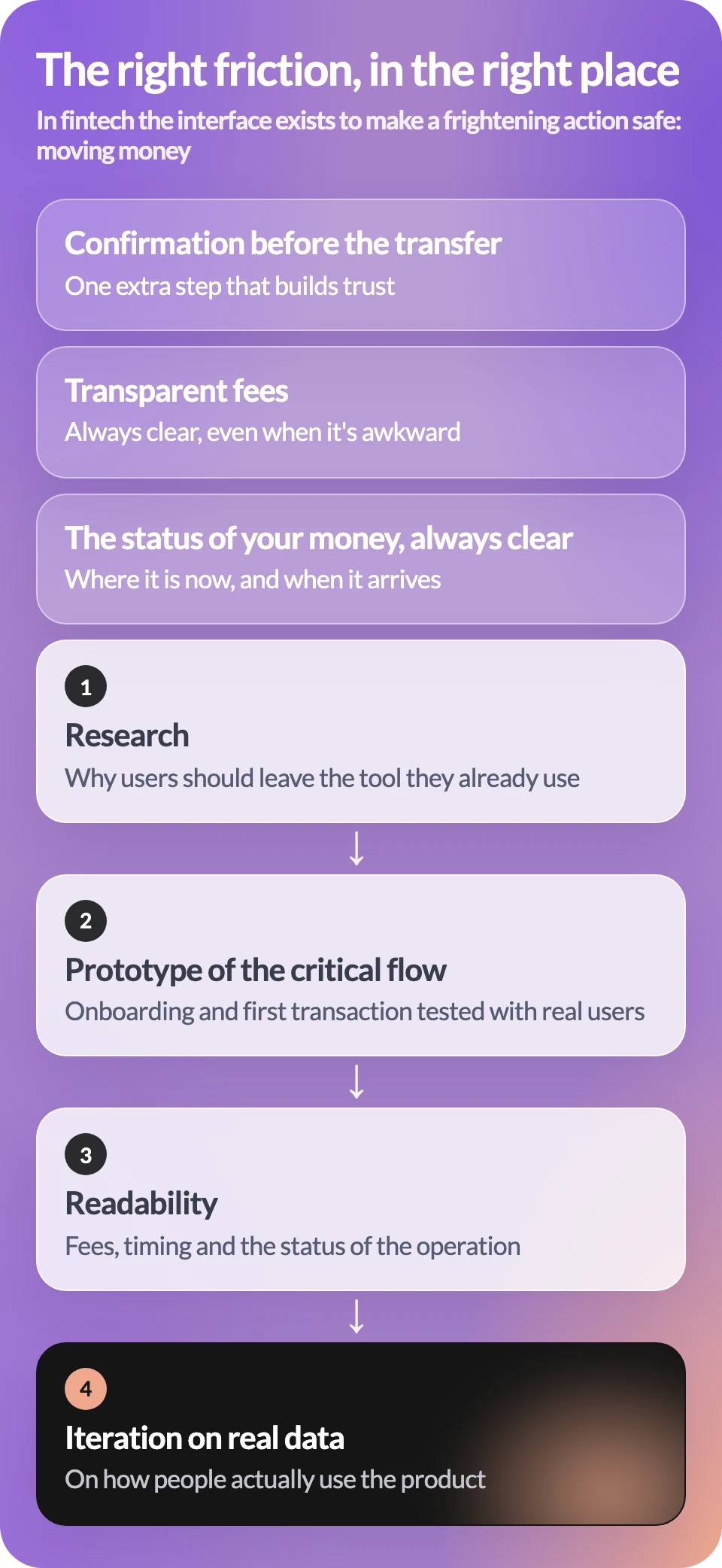
In fintech, UX isn't measured by the "wow" effect. It's measured by how understandable and safe you make an action that is inherently scary for the user: moving money, sharing bank details, authorizing a charge. Mature UX means one more confirmation before a bank transfer, full transparency on fees, an always-clear status of where my money is right now: these are frictions that build trust, not obstacles to remove.
- Start from research, not from your assumptions. Understanding why a user should leave the tool they already use for yours matters more than any feature.
- Prototype the critical flow before building it. Test onboarding and the first transaction with real users before writing the code you'll go to production with.
- Design for readability, not just for looks. Fees, timing, transaction status: always clear, even when it's uncomfortable.
- Iterate on real post-launch data. Trust is earned over time, and the interface should be corrected based on how people actually use the product, not on how you thought they would.

Infrastructure: in fintech, scalability means audits and continuity, not just peaks
Modular because the rules change, and you have to keep up
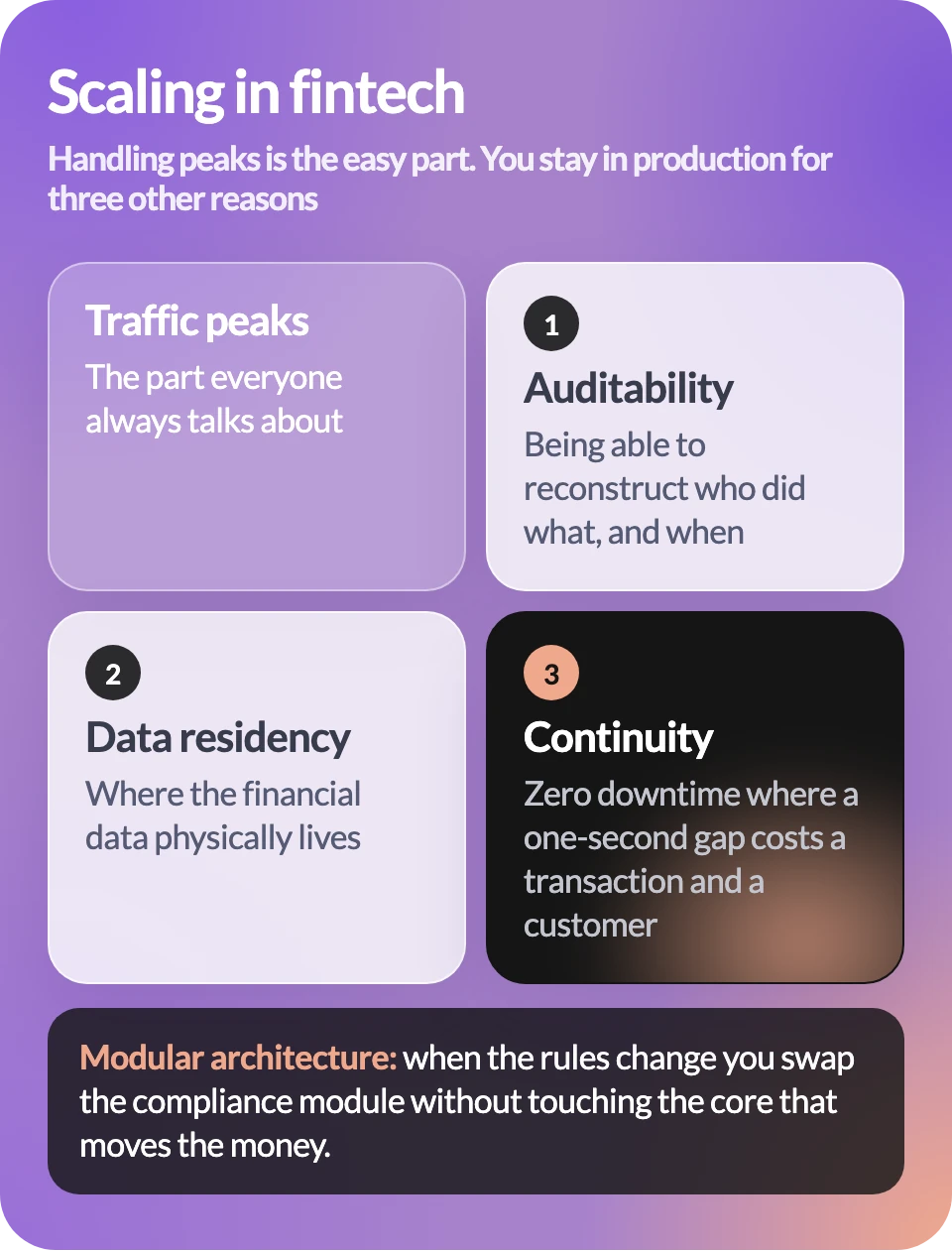
Scalable cloud infrastructure in fintech is almost always described as the ability to handle traffic peaks. That's certainly the easy part. What separates the products that stay in production from the ones that blow up is something else: auditability (being able to reconstruct who did what and when), data residency (where financial data physically "lives") and continuity in money movement (zero downtime, where a one-second gap costs a transaction and a customer).
- Choose your provider for compliance and support, not just price. Evaluate public, private and hybrid cloud against regulatory constraints, not market trends.
- Build truly modular. You need to be able to replace a compliance module, because the rules will change, without touching the core that moves the money.
- Monitor what matters in real time. Not just uptime: transaction integrity and security signals too.
- Automate resource management. Less manual work means fewer human errors on the most critical paths.

For companies already in fintech that want to launch a new vertical, this is even more true. BCG estimates the embedded finance market at over $320 billion in revenue by 2030, with SMEs accounting for about half of it: the winners in that space don't build the fastest product, they build the most integrable and most compliant one.
Conclusion
The right question isn't how fast we go live. It's this: can our product withstand an audit, a fraud incident and a traffic spike while keeping users' trust? In fintech, these three things aren't details to deal with later; they're the difference between a prototype that works and scales and a prototype that stays a prototype.
The case we started from, two months from prototype to stable production, isn't a story about speed. It's a story about decisions made early: separating the regulated path from the rest, putting AI only where it cut a risk or added value, designing the UX properly, and building the infrastructure for audits before traffic. You can make these decisions in-house or rely on someone who has already made them dozens of times. Either way, they have to be made before you write the code that matters, not after.
FAQ
How long does it take to get a fintech MVP into production?
It depends on how broad the regulated path is, but it can be done quickly: on a recent consumer fintech project we reached stable production in two months. The condition is deciding from the start what had to be production-grade (onboarding, KYC, money movement) and what could stay light and iterable.
What's the most common mistake when scaling a fintech product?
Treating compliance and security as something to add after launch. It's the decision that most often forces you to rewrite the architecture from scratch.
Should you build compliance into the MVP or add it later?
Into the MVP, at least on the critical path. You don't need to comply with every conceivable rule from day one, but you do need to identify which regulations actually apply to your product and build the regulated core (identity, anti-money laundering, audit trail) production-ready from the start.
Where does AI really make sense in a fintech product?
Where it reduces a measurable risk or operating cost: real-time fraud prevention, onboarding and KYC automation, data structuring. Much less where it only serves to look innovative, like general-purpose chatbots that often work poorly and, above all, aren't useful.
Do you need an in-house tech team to launch a fintech vertical?
Not necessarily a full-fledged one. Many companies already in fintech have the brand, the distribution and the commercial agreements, but not fifteen in-house tech people. In those cases it makes sense to work with an execution partner that builds the product behind the scenes, with your face out front, instead of holding up the launch while you hire a team you very likely won't be able to oversee properly.
What does "modular architecture" mean in practice for a fintech?
It means designing the system as replaceable components, so you can update or swap one piece (typically a compliance module, when regulations change) without touching the core that moves money or handles transactions. This lets you evolve without rebuilding everything.
Need to take a fintech product into production?
Start now with Mokka Studios and turn your ideas into measurable results through innovative software development practices.




















Sharp Decisions. Sharper Execution. Let’s Build Something Great.


Message Sent