
Message Sent


White Label Software House in Milan: When You Need a Tech Partner
What it really means to rely on a white label software house, and why, in the age of AI, a partner that can take a product all the way to production matters more than ever.

In Milan, dozens of companies present themselves as white label software houses. Almost all of them mean the same thing: a ready-made product they built, which you adopt or bring to market under your own brand. For many needs, that's perfectly fine. For a product that has to scale internally or toward your end customers, it isn't.
In this article we separate the two models hidden behind the term "white label" and explain why today, with AI putting software production within anyone's reach, the choice of partner matters more than before. We start from a real project: a platform built for an international facility management group, from the first PoC to production, with the client owning all the code.
If you run a company that sells a product or service with a digital component inside, you know the pressure. The customer wants the app, the platform, the portal, and wants it rock-solid. But digital isn't your trade. You have two paths: hire, building or growing your own tech department, or rely on people who do this work professionally, which lets you focus on what you're probably already doing well, namely selling that product.
What "white label" means in software
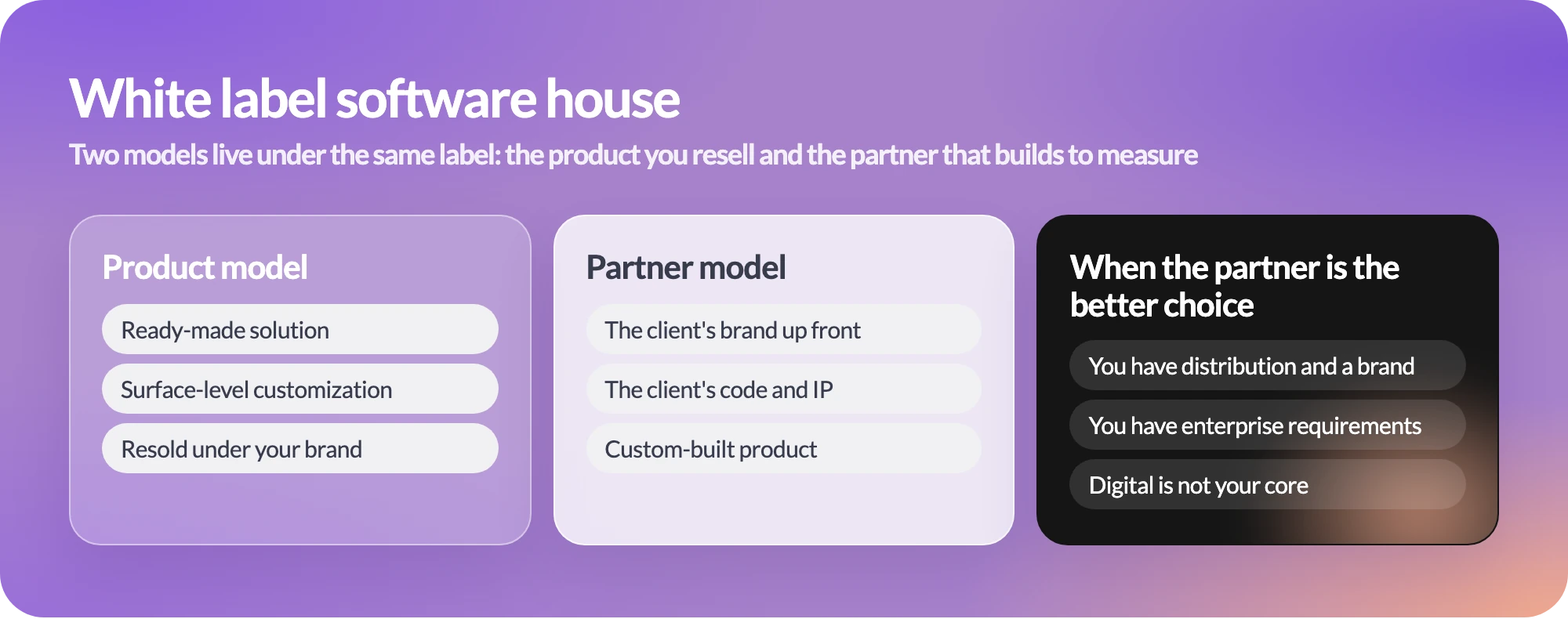
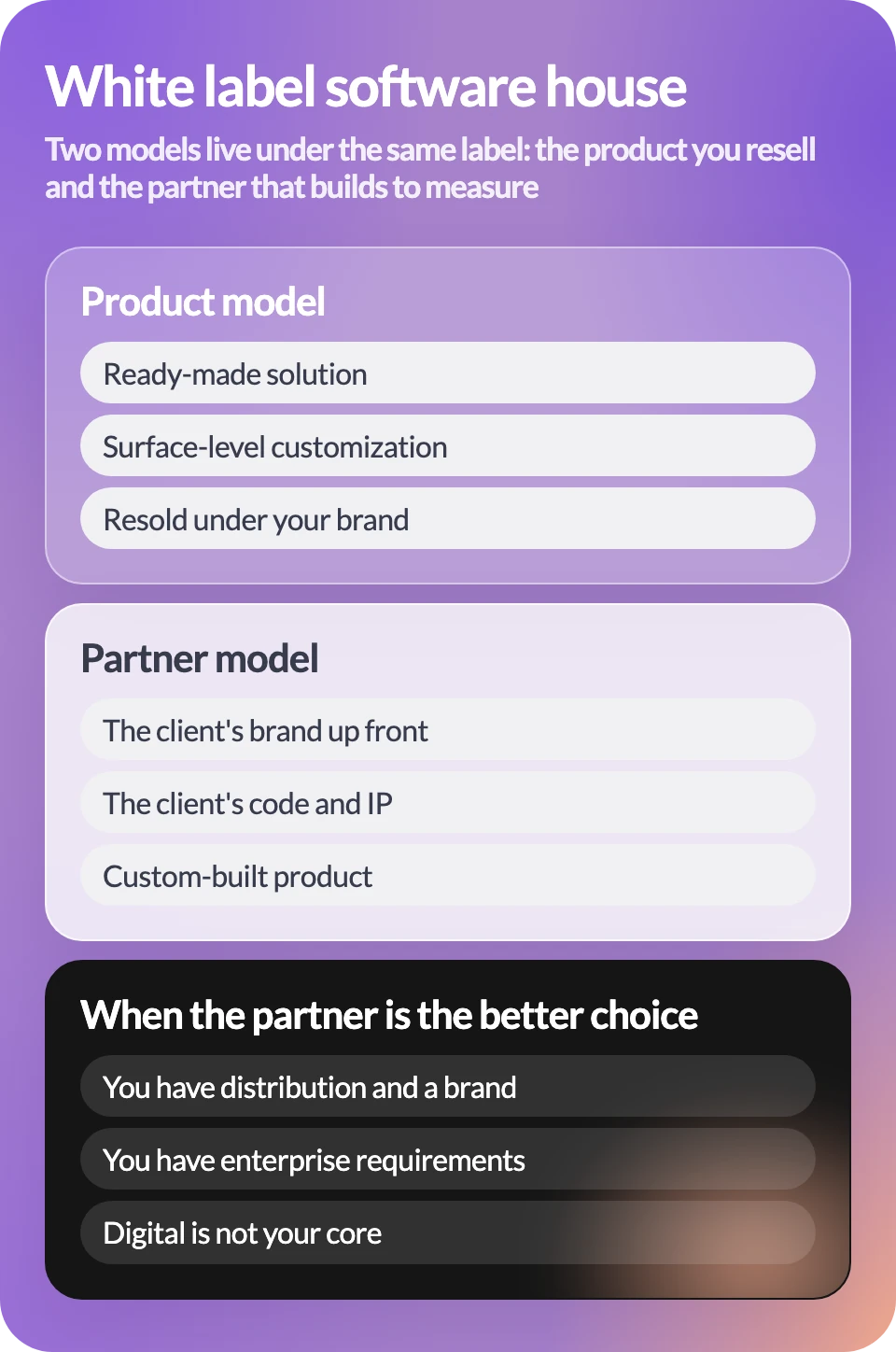
In the first model, white label means taking a generic, already-built product, a management system or an app of any kind, and reselling it under your own brand after some surface customization. It's fast and cheap. It works when your need looks like that of a thousand other companies.
In the second model, white label means having a partner build the product to measure for you, the way your in-house team would, and deliver it under your name. Here you build something of your own, just like a tailored suit, instead of taking one off a generic shelf: the code is yours, the intellectual property is yours, and the product follows your processes.
The cost difference between the two models is often the least relevant issue, because the two rarely end up far apart, especially when a generic product then has to be adapted to the needs of the specific company adopting it. What matters is how far the product can go. Software meant for an enterprise client, with strict security and integration requirements, rarely fits the off-the-shelf model. And this is where choosing the wrong one of the two models costs you months lost forcing generic software into a use it was never designed for.
Why the AI era raises the stakes
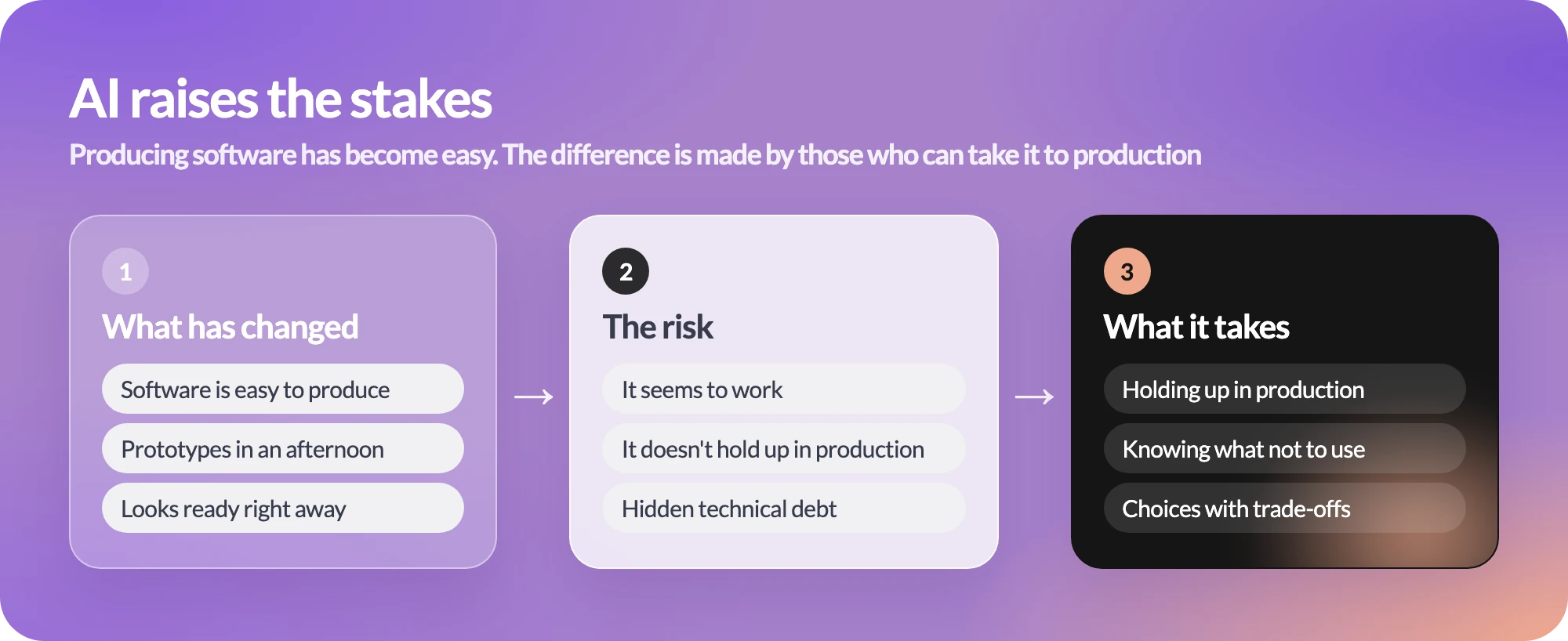
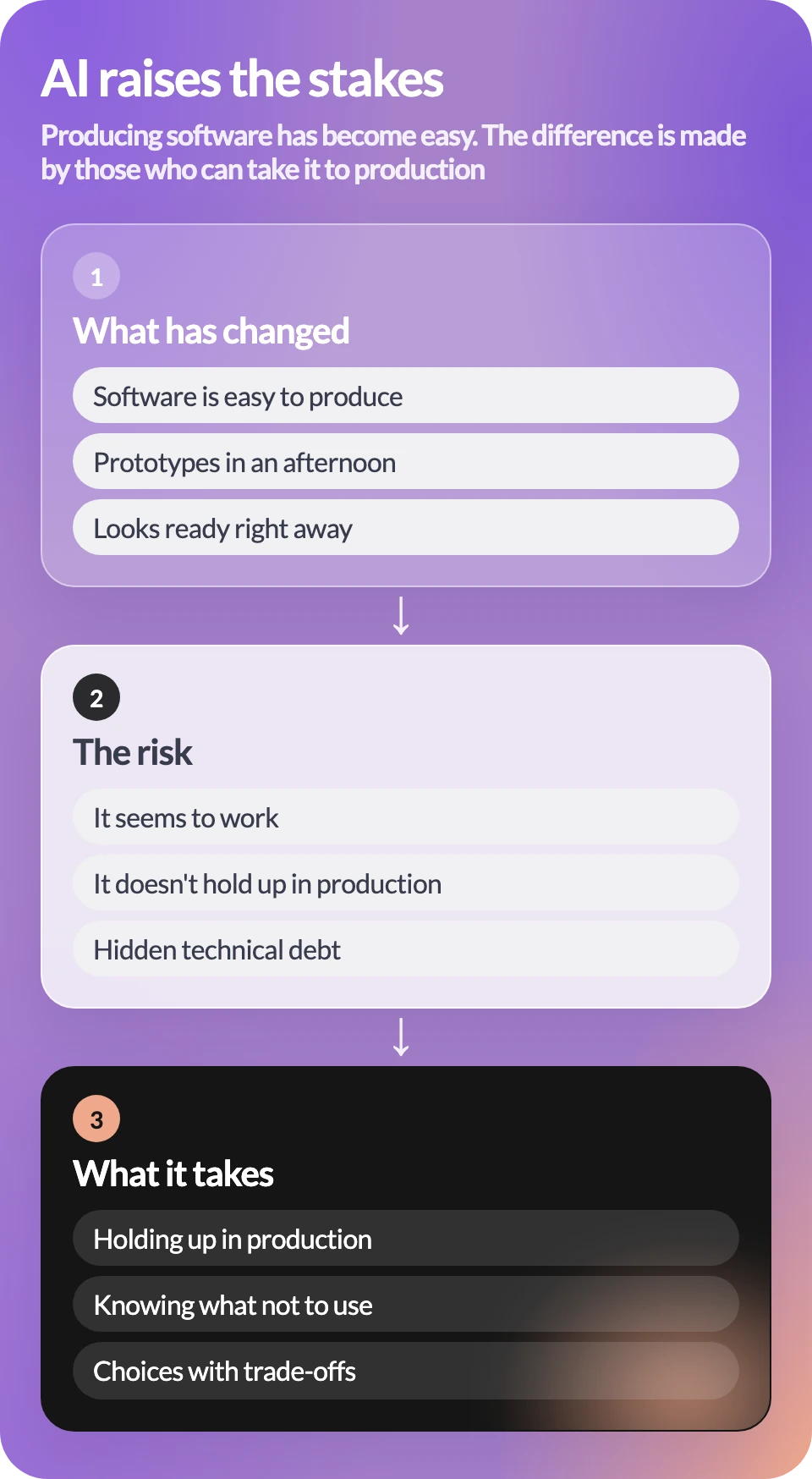
Until recently, building software took time and skills that were visible to everyone. Today AI tools have lowered the barrier: a working prototype comes together in an afternoon, and at first glance it looks ready. This has convinced many people that software is now a commodity anyone can make.
The opposite is true. The easier it gets to produce something that looks like it works, the rarer it becomes to know how to build something that works when thousands of people, sensitive data and an audit are involved. The problem has always been the same, then and now, AI included: making code hold up in production when everyone, users or end customers, expects it to work.
We use AI, more every day, but we know where, how and when it's needed. Before starting production, we validate the idea with a prototype built in a few days: on a recent project, one week was enough to show the client how the flow would work and decide whether it was worth moving forward. But when it came to taking the platform to production, we left some features that looked convenient with AI, such as automatic data extraction from documents, out of the first release: in an audited purchasing process, an automated margin of error wasn't worth the risk.
That's exactly the point: knowing how to use AI today means knowing what to have it do and what not to.
When building an in-house tech team doesn't pay off
There's an understandable reflex: if digital is important, I have to bring it in-house. That isn't always the right move. Building a real tech team means bringing together different roles (development, design, DevOps, QA, project management) and keeping them, in a market that competes for them ever more aggressively, even after the workload peak has passed. It makes sense if software is your main product and you're developing it all the time.
If, on the other hand, your product is something else, and software is the lever that makes it sellable or makes it better, setting up an internal structure for a single major project is almost always uneconomical. You spend months building the team before you even start on the product, and when the product is done you're left with a fixed cost you no longer know how to fill.
Handing execution to a partner keeps you focused where you create value: your product, your sales, your customers. Many of the companies we work for have their own IT department, and a good one. Still, they know its limits and call us for the things that fall outside its scope, or that they can't afford to get wrong.
What a technology partner does in practice
A concrete example, anonymized because it's covered by confidentiality. The client is an international facility management group: it sells services, not software. It had a critical process running on Excel spreadsheets: the purchases technicians make in the field directly from suppliers, known as over-the-counter purchases. There was no real-time control over the job budget and traceability was weak, with a constant risk of spending over the cap.
We built a web platform from scratch that governs the entire flow. Every purchase goes through a unique electronic voucher tied to an order and a job; the system calculates each order's remaining headroom in real time and blocks the transaction if it would exceed the cap, with an automatic alert when the budget drops below a configurable threshold, set to 20% by default. One precise rule holds it all together: one voucher generates only one delivery note, so purchases can't be split or bundled on the same voucher. Every action goes into an immutable log, designed for audits.
On the technical side we used React and Next for the frontend and Supabase for database and authentication, with infrastructure on Google Cloud and Vercel and data hosted in Europe for GDPR. One choice says a lot about our method: from the start, we kept the client's ERP outside the platform's scope. The accounting status of orders stays in the ERP; the platform governs only the operational status of purchases in the field. It's a clean boundary that avoided a costly, fragile integration and kept the project on a more than acceptable timeline.
From the first PoC to production, the journey took a few months, with incremental releases validated by the client at every sprint. And one detail says everything about white label done right: the code and all the intellectual property belong to the client, from day one. We built it; they own it.
How to recognize the right partner
If you're evaluating a white label software house, in Milan or elsewhere, price and portfolio tell you little. What counts is how it works. A few signs that set a partner apart from a plain Time & Material vendor:
- It talks to you about what it takes to get to production. Anyone who downplays the distance between demo and release has never crossed it.
- It tells you no. It drops features that add risk instead of going along with everything.
- It leaves you ownership of the code and IP, put in writing from day one.
- It releases in pieces and has you validate every step, instead of disappearing for six months and coming back with one big block.
- It thinks about your processes more than those of your market.
None of these points, on its own, is a guarantee. Taken together, they separate those who build products from those who sell man-hours.
Conclusion
"White label software house" is a label you'll find on dozens of websites in Milan. Underneath, there are two distinct models: the product to resell and the partner who builds. For standard needs, the first is enough. For a product that has to hold up in front of a major client or an audience of thousands of users, you often need the second.
AI has only made this logic more obvious. Now that producing something is easy, the difference comes from those who know how to take it all the way to production and know what to leave out. Before asking how much it costs to build the product, ask who will keep it running the day after go-live, when your customers, whoever they are, are using it.
FAQ
What does a white label software house do?
It builds or supplies software that another company sells or uses under its own brand. In the product model, it gives you a ready-made solution to customize; in the partner model, it builds the product to measure and leaves you the code and the intellectual property. The two approaches serve different needs.
Which is better: a ready-made white label product or a development partner?
It depends on how standard your need is. If you need a common, non-differentiating function, a ready-made product can be faster and cheaper. If the software has to meet enterprise requirements or become a competitive advantage for you, a partner who builds to measure avoids the limits of a generic product.
Do I need an in-house tech team to work with a software house?
No. Many clients don't have a CTO or a structured IT department, and the partner acts as their external tech team. It's what we call a "Team-As-A-Service." Companies that already have an in-house department often bring us in for projects that fall outside its scope or that they can't afford to get wrong.
Who owns the intellectual property of the software?
In a serious relationship, the client. In our projects, the source code and all intellectual property rights belong to the client from the start, put in writing in the contract. We build it; the product stays yours.
How much does AI affect product development?
AI speeds up the validation of an idea: a PoC that used to take weeks can now come together in a few days. But it doesn't replace the engineering choices that make a product hold up in production. The value lies in knowing where to use it and, above all, where not to.
Have a product to build, but not the team to build it?
Start now with Mokka Studios and turn your ideas into measurable results through innovative software development practices.













Sharp Decisions. Sharper Execution. Let’s Build Something Great.


Message Sent