
Message Sent


Loyalty agencies: what breaks when programs go from 1 to 8 countries
When a loyalty program has to scale from one country to eight, the architecture is what's most at risk. What we learned building one for a Fortune Global 500 industrial brand.

A loyalty agency selling to an enterprise client rarely loses the pitch on the concept. The concept is what it knows how to do: cashback mechanics, rewards, tiers, gamification. Things get complicated later, when the client is happy with the program in Italy and asks to take it to Germany. Then Luxembourg. Then five more markets.
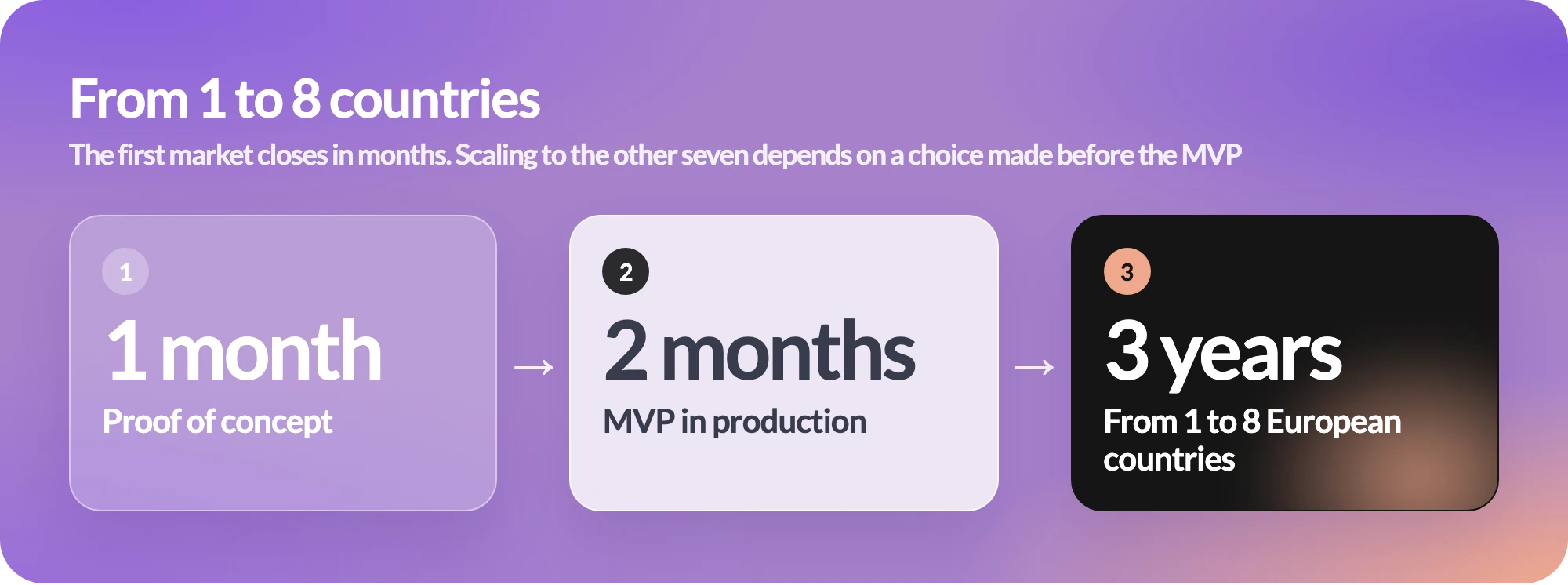
We built a B2B2C loyalty program for an enterprise industrial manufacturer that followed exactly this path: it started in one market and now runs in eight European countries. The interesting part isn't the program itself. It's what breaks when you try to replicate it, and why whoever designed it with a single country in mind ends up rewriting everything at the second one.
If you're a loyalty agency and you build your digital product with freelancers or an understaffed in-house team, this article is about the wall you're going to hit. Not when you launch, but when it works and you have to replicate it.
The program's user interface isn't the bottleneck
There's a common misconception: that the hard part of a loyalty program is designing the right rules. In reality, the rules of a cashback program fit on one page. You earn points or euros on certain purchases, you redeem them under certain conditions, and the system verifies that the purchase is real.
The real complexity lies elsewhere. In the case we built, the end user isn't just any consumer: it's an installer or a reseller who scans the barcode of a product they bought and in return receives real cashback into their bank account, up to tens of thousands of euros. That flow touches product verification, fraud prevention, the payout of real money, and the warranty extension tied to each individual unit sold. A mistake here isn't a cosmetic bug: it's money going out to the wrong person.
Where it really breaks: going from one country to many
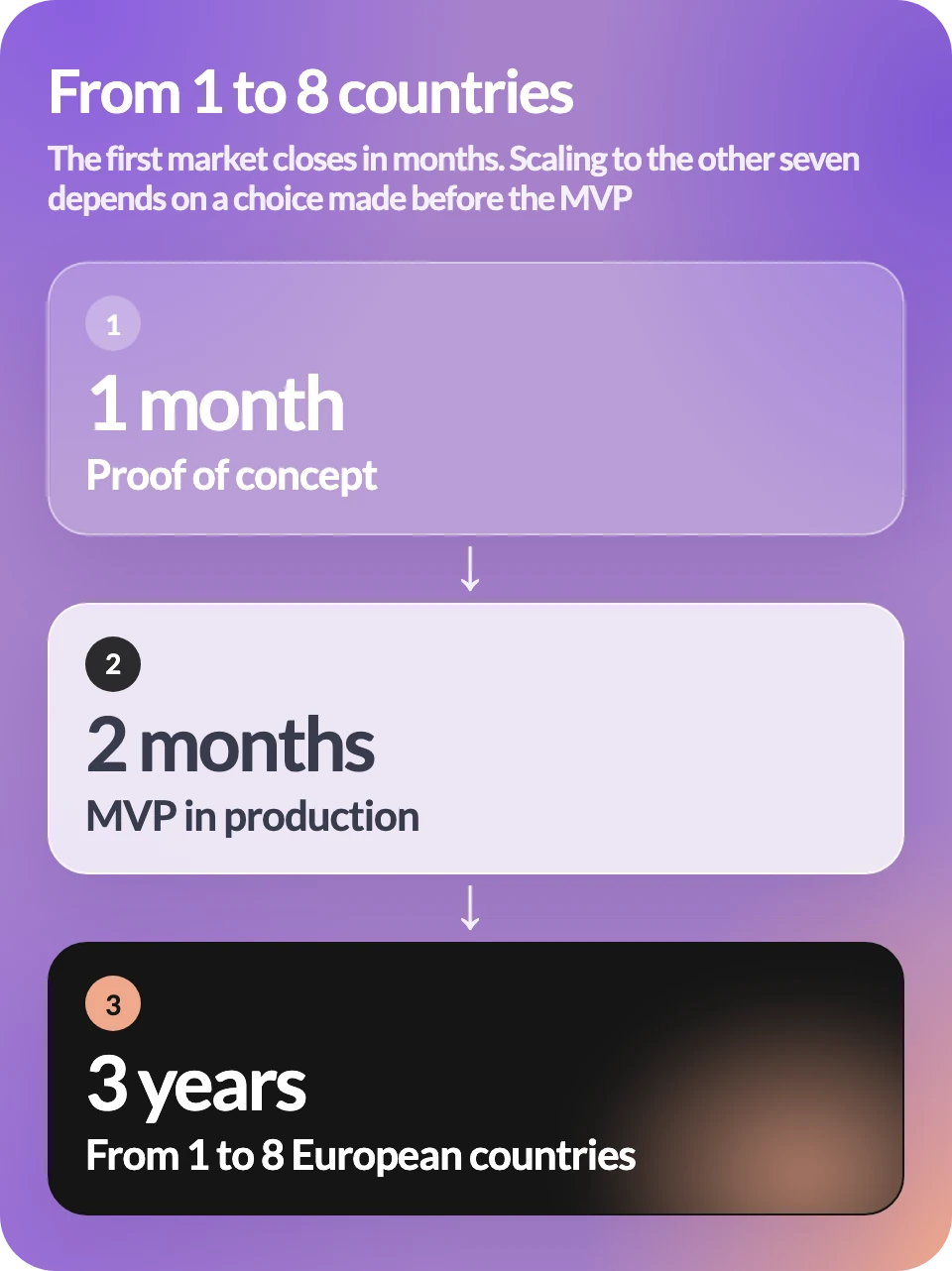
The first country you wrap up quickly. In our case: one month of proof of concept to validate the mechanics, two months to reach an MVP in production. Three months, and the program was live in the first market. That's the point where anyone who built it badly starts paying the bill.
Every country has its own rules, but you don't want eight codebases
Germany has different tax and payout rules from Italy. Luxembourg has its own thresholds and its own participating resellers. When the first country was built in a hurry, the natural temptation is to duplicate the project and adapt it. Do it twice and you have two codebases to maintain. Do it eight times and you have a nightmare: every bug has to be fixed eight times, every new feature has to be discussed eight times, and sooner or later the eight versions drift so far apart that they're no longer the same product.
There's only one alternative: a multi-market architecture designed from day one, where the country is a configuration parameter and not a copy of the code. Tax rules, currencies, product catalogs, resellers, cashback thresholds: all of this lives in the data, not in the logic. Adding the eighth country should cost as much as filling in a configuration table, not as much as redoing a project.
Why an understaffed in-house team struggles right here
This architectural choice has to be made before you write the first line of useful code. That's exactly when a loyalty agency has the least visibility: you're validating whether the enterprise client will buy, you don't yet know whether the product will be able to scale, and the pressure is to deliver something fast so you don't lose the end client's trust.
An in-house team built for one project optimizes for the launch, because that's what it's asked to do. Nobody builds a multi-country architecture for a program that will initially run, say, only in Italy, unless they've already seen it break before. That's where the value of an execution partner who has already taken this kind of product to scale lies: it already knows the expensive decision that has to be made at the start, and doesn't discover it at the second country, when fixing it costs ten times as much.
What to actually look for in a tech partner
If you're choosing who will build your loyalty product, the useful questions aren't about their portfolio. They're these:
- Have they already built systems that pay out real money, not just points to spend in a rewards catalog? Paying money into a bank account is a different job from scaling a points balance.
- When you ask how they plan to handle the go-live in other markets, do they talk about configuration or about a new project? The answer tells you whether they've understood the scalability problem we just described.
- Do they deliver the whole product end to end, meaning strategy, design, development and integration, or do they hand you just a piece of code and leave you to assemble the rest?
It's not the only possible checklist, but it's the one that separates those who get you all the way from those who don't even make it to the second market.
Conclusion
To sum up, the moment a loyalty program proves its value isn't the launch in the first country. It's when the enterprise client is happy and wants another one, and you can say yes in weeks instead of months. That speed, as we saw at the start, doesn't come from good program design. It comes from an architectural decision made months earlier, when you didn't yet know you'd need it.
So the question to ask yourself isn't whether your program works today. It's this: if tomorrow your client asks you to go after a third country, are you starting a new project from scratch?
FAQ
How long does it take to launch a loyalty program in a first market?
It depends on how complex the mechanics are, but a realistic path is about one month of proof of concept to validate the flow and two months for an MVP in production. The risk isn't the time to first launch: it's not having prepared the architecture for the second, third, fourth (and so on) market.
Why should a loyalty agency rely on an external tech partner instead of an in-house team?
Because the value of a partner who has already taken this kind of product to scale lies in the fundamental decisions made at the start, especially the multi-market architecture, which a team built for a single project rarely tackles until it breaks.
What makes a cashback program more complex than a points program?
Cashback pays out real money. That brings in purchase verification, fraud prevention and the actual payout of funds, with a much higher level of risk than a system of symbolic points.
What does multi-market architecture mean for a loyalty program?
It means the differences between countries (tax rules, currencies, catalogs, thresholds, resellers) live in configuration data, not in the code. Adding a country becomes a configuration task, not new development.
How many codebases does a loyalty program running in several countries need?
Ideally just one. Duplicating the code for each country leads to versions that drift apart over time and multiply the cost of every fix and every new feature.
Need to take your product, or your client's, into new markets or countries?
Start now with Mokka Studios and turn your ideas into measurable results through innovative software development practices.
















Sharp Decisions. Sharper Execution. Let’s Build Something Great.


Message Sent