
Message Sent






AI-Ready Data: Enriching Raw Data So AI Actually Works
Building an AI assistant is easy today. Making it reliable depends on the data it reads. How we enriched 2 million products from raw sources, and why the method applies to every industry.

An AI assistant is only as good as the data it can read. You can connect the best model on the market to a flawless conversational interface: if there's an inconsistent catalog underneath, it will confidently give the wrong answer. That's the gap between a demo that wows and a product that holds up in production.
We saw it up close while building an AI-based fashion product discovery platform: a conversational assistant that finds the right products from a written request or an image. The core isn't the chat. It's the proprietary database underneath: more than 2 million products collected from over 250 third-party sources, automatically normalized and enriched so the multi-agent system understands what to suggest, and why.
Over the past two years, building a conversational agent has become almost trivial. An LLM, a vector database, a few tools, and in one afternoon you have a prototype that talks well. That's exactly why we know that today the prototype is the easy part, while the hard part is the data you feed it.
It's also why an AI system amplifies flaws instead of hiding them. A wrong data point in a report gets corrected by a person sooner or later. The same data point inside an AI system generates hundreds of wrong answers automatically, with the same confidence it would give right ones. Fashion is just the example we start from: the same problem applies to finance, manufacturing, logistics and any industry that brings AI to its own or third-party data.
Where a wrong answer comes from
When an external source opens up its catalog to you, it doesn't hand you tidy data. We can safely say that, in our long experience, we have never found it that way. On top of that, in the case mentioned above, the feeds came from the major affiliate networks, from Awin to CJ, from Rakuten to Tradedoubler, and behind them were more than 250 affiliate partners, more than 2,000 brands and more than 2M unique products. And every feed comes with its own rules.
In practice, 250 sources mean up to 250 different ways of naming the same category. The exact same product shows up on several networks, in versions that look nothing alike. Descriptions range from a complete spec sheet to three words thrown together. The attributes a semantic search engine needs, such as color, material, fit and occasion, are sometimes there, often missing, and when they are there they come in different languages. With 2 million products refreshed every two weeks, this isn't a problem you solve by hand.
The same pattern repeats outside fashion, in every industry. An insurer that wants to query its policies with AI finds the same fields filled in ten different ways by ten branches. A manufacturer that puts AI on its production data finds that the data is there and correct, but doesn't say under what conditions it was generated. The domain changes; the shape of the problem stays the same.
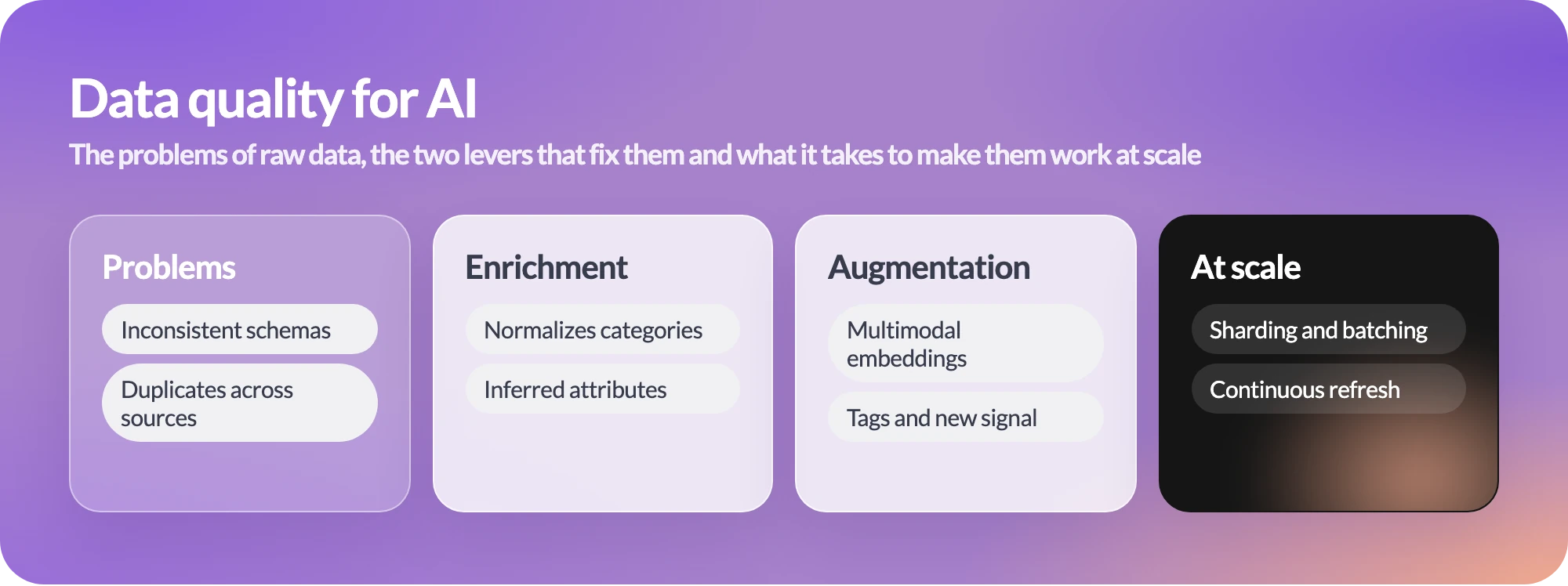
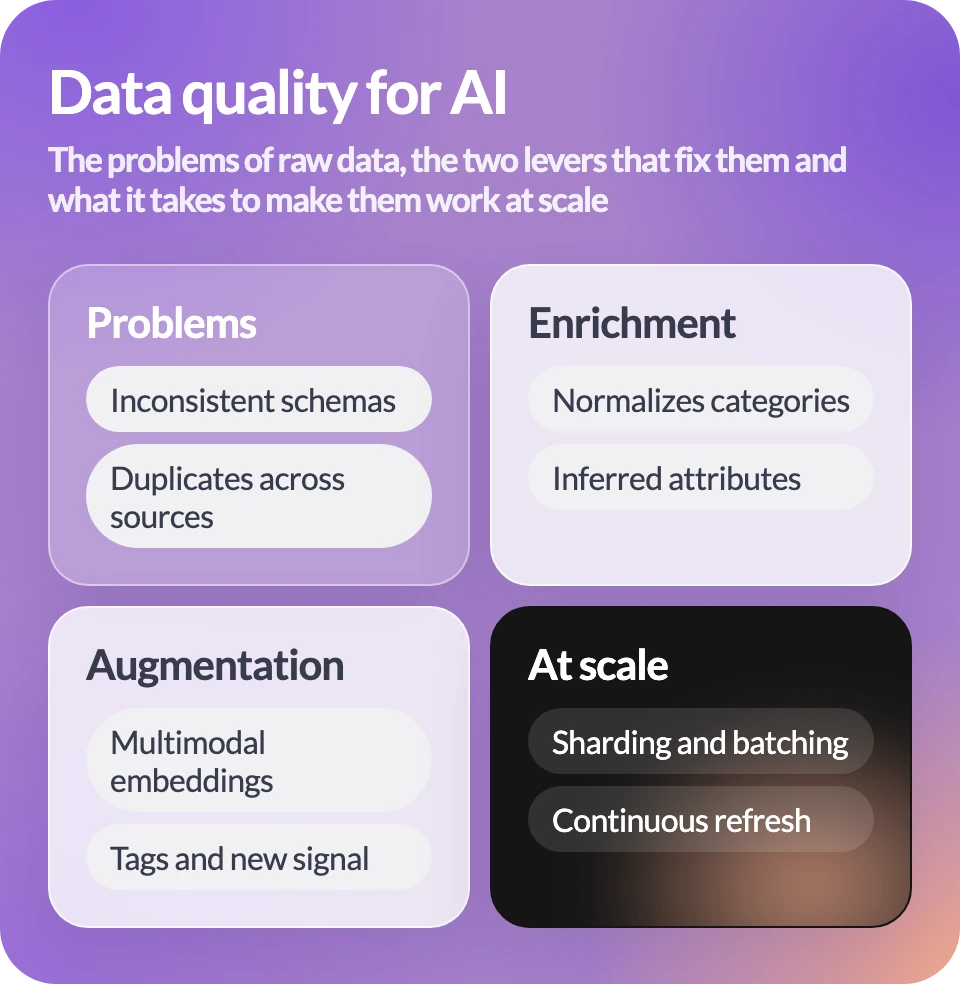
Enrichment and augmentation: two overused words, one precise meaning
In machine learning jargon, "data augmentation" usually means rotating and cropping images to train a vision model. Here we mean something different, and closer to the real problem of anyone bringing AI to their own data.
Enrichment means making data that arrives inconsistent and incomplete consistent and complete. Normalizing 250 taxonomies into one. Recognizing that two listings from different networks are the same product and merging them. Inferring the missing attribute, such as the color nobody filled in or the wrong category that needs correcting, from the title and the image.
Augmentation, in our sense, means generating new signal that the raw data didn't carry. The main case is multimodal embeddings: turning each product's text and image into vectors that live in the same space, so that a user's request, typed or photographed, lands close to the right products. This is data that didn't exist before, and it's what makes semantic search possible.
The distinction has practical consequences: it changes who does the work. Today we hand enrichment to a chain of AI agents, models that read the messy data, classify it, fill in the attributes and flag what doesn't add up. It's AI used to prepare the data for another AI.
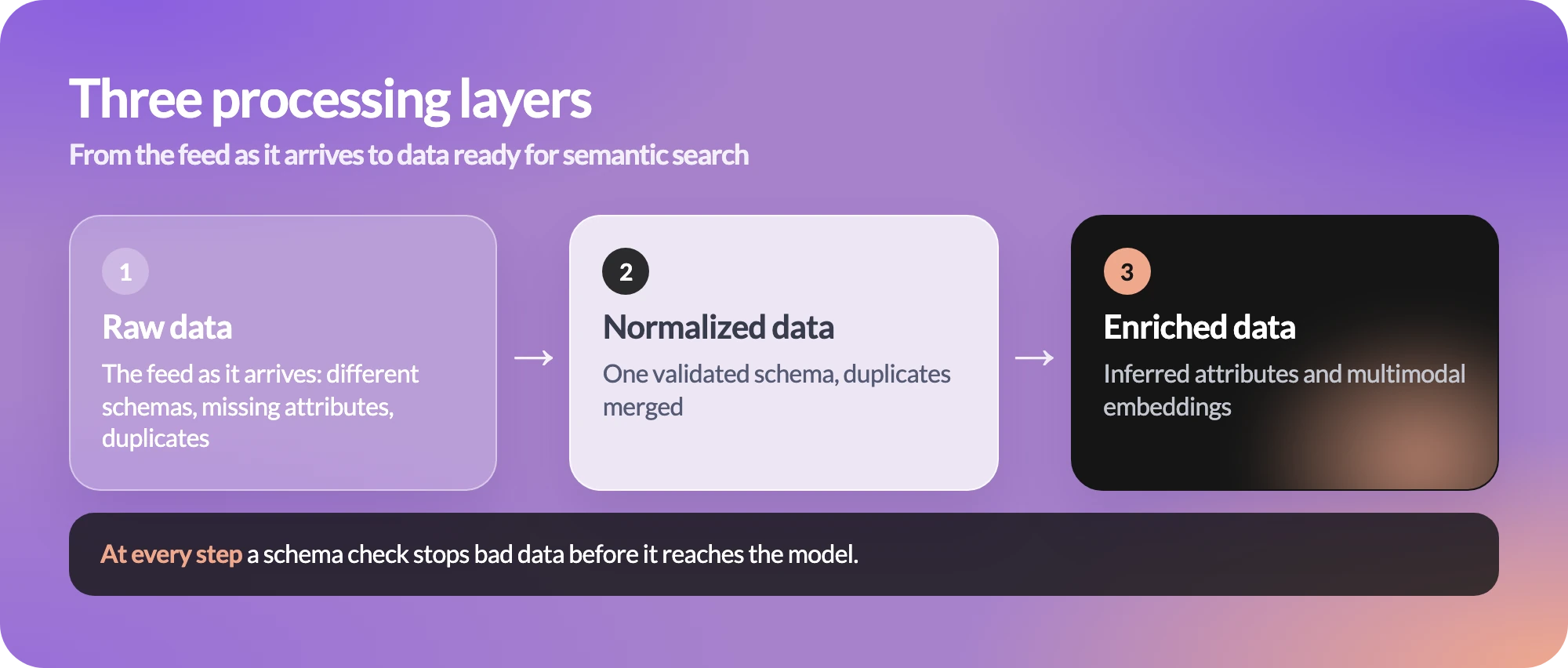
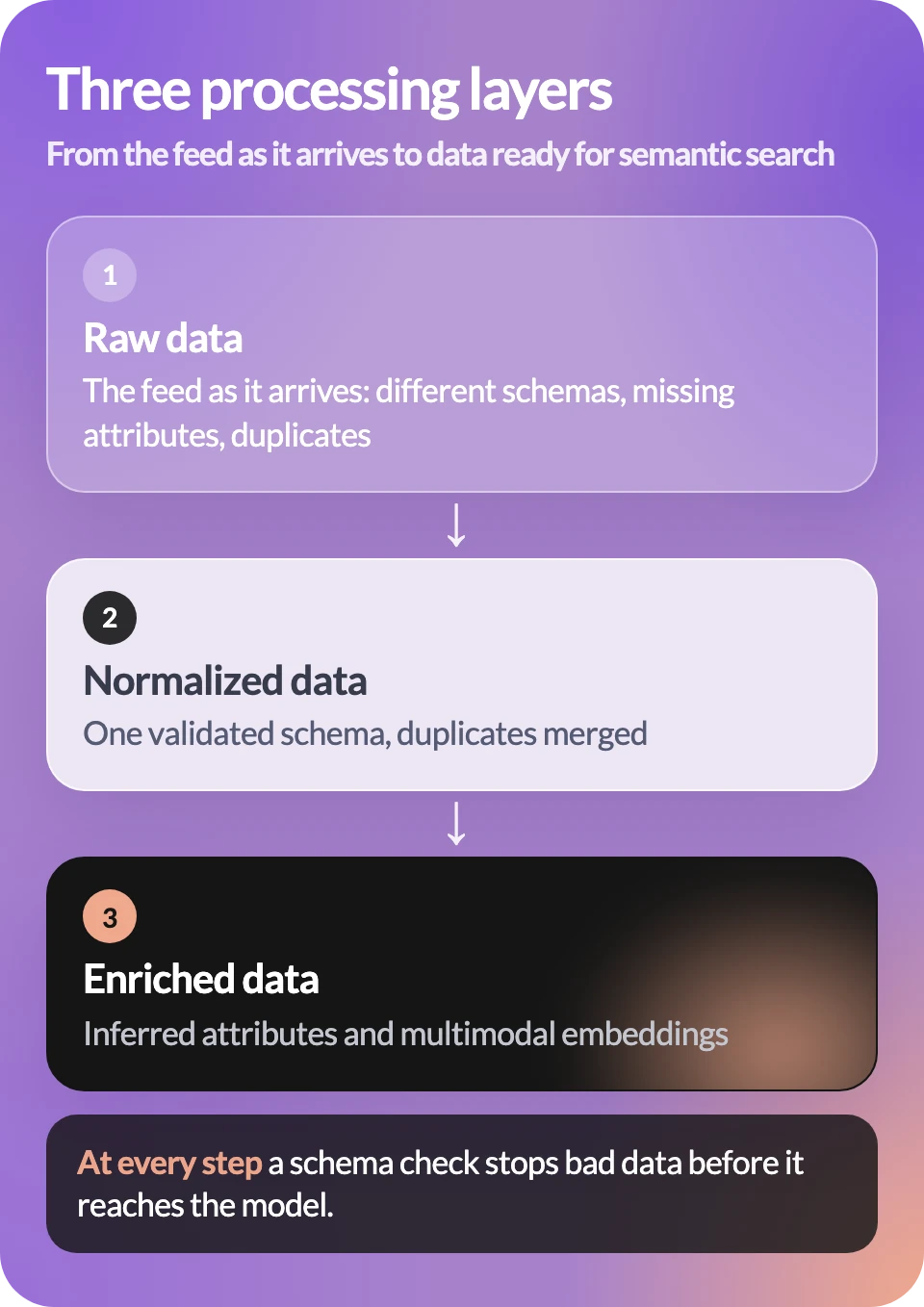
How to build an enrichment pipeline that holds up at scale
Cleaning a million rows in a notebook is an exercise. Doing it every two weeks, automatically, without a human touching anything, is a system. Here's how the one we built for the case mentioned at the start works.
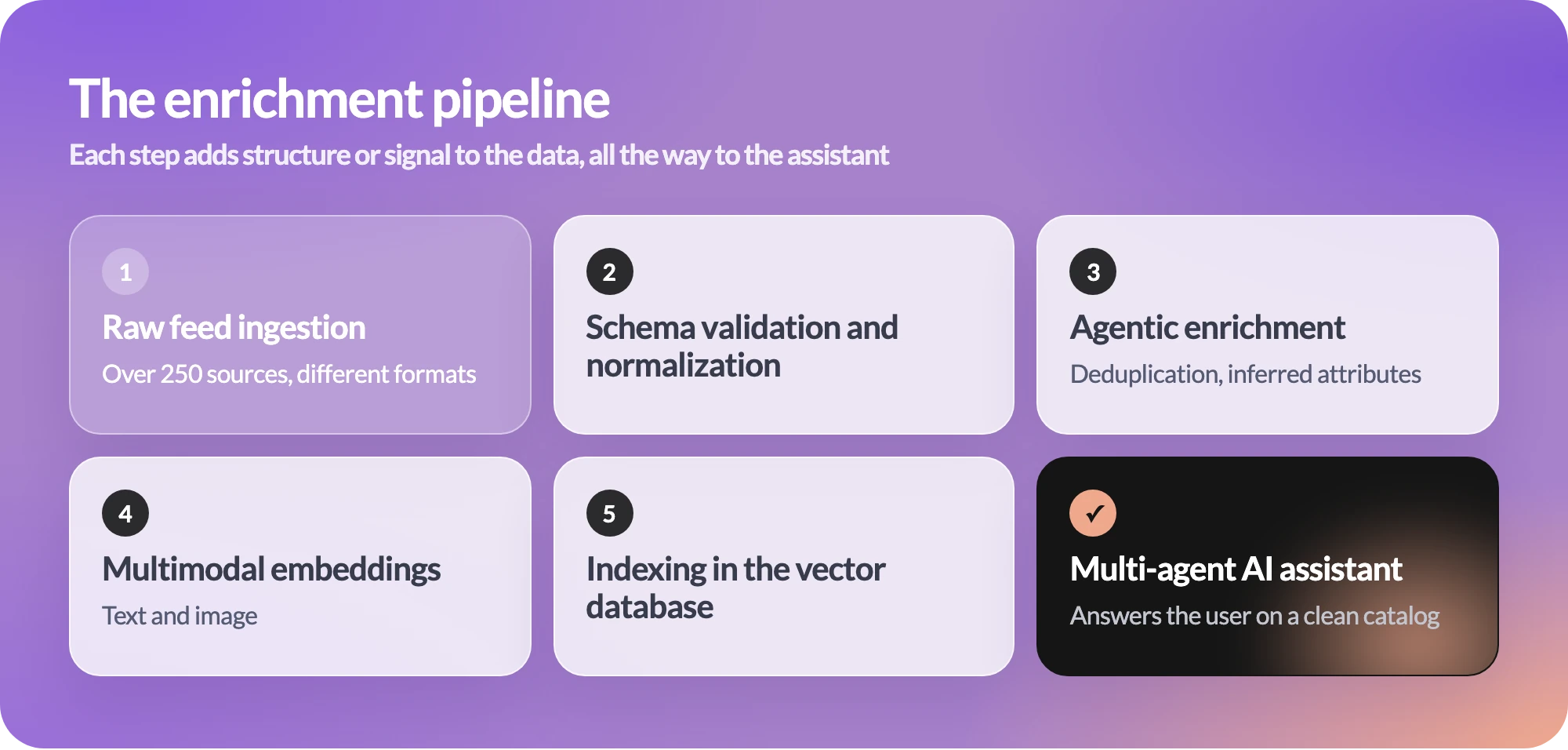
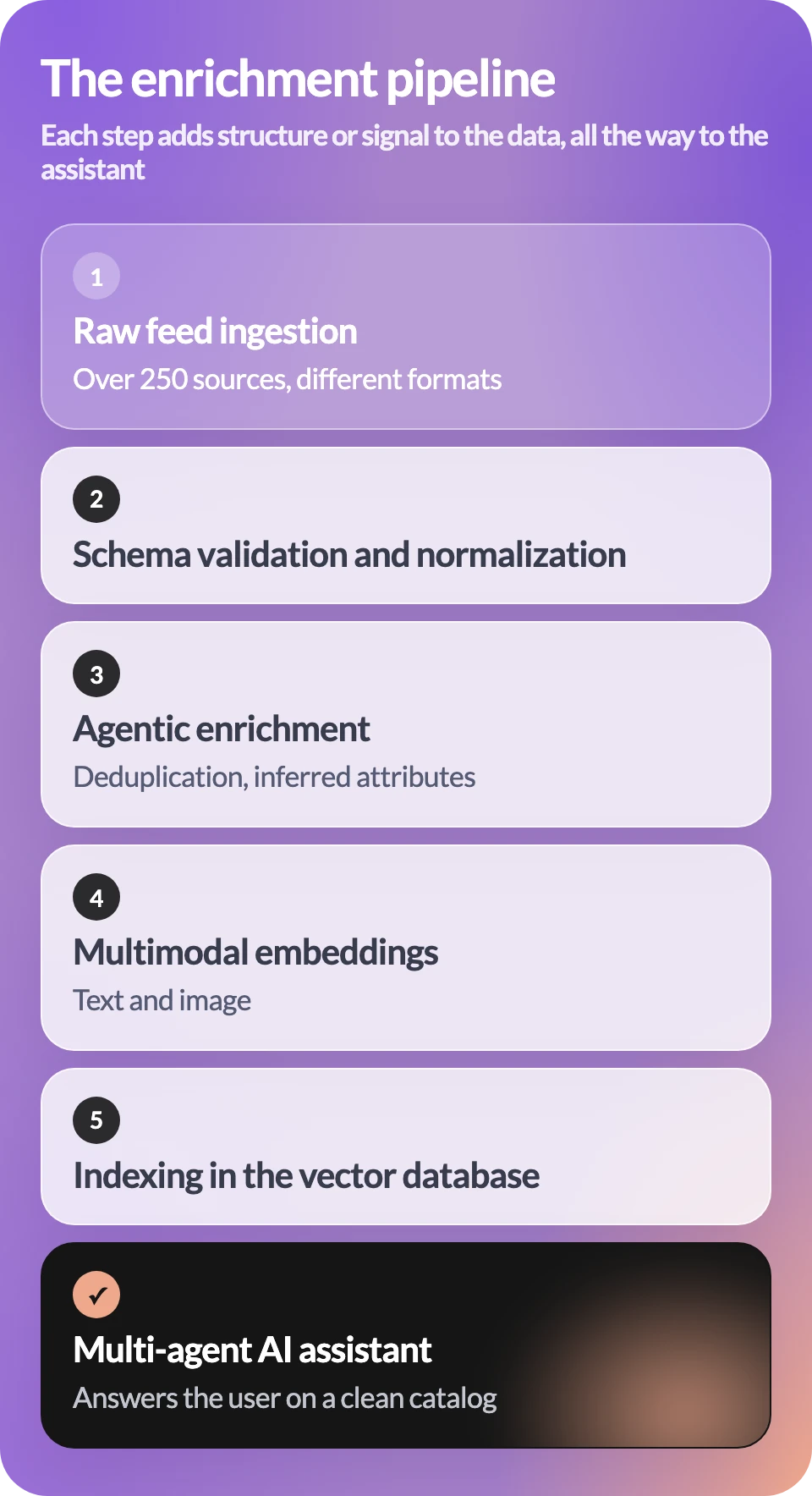
The data goes through successive layers: a first layer takes in the raw feed as is, a second brings it to a single validated schema, a third enriches it with inferred attributes and embeddings. Every layer has a schema check: if a feed changes format without warning, and that happens all the time, the pipeline catches it instead of passing garbage downstream.
Enrichment is handled by a chain of specialized agents, each with a narrow task: normalizing categories, deduplicating, inferring missing attributes, generating embeddings. It's a serverless pipeline: it runs as jobs on Google Cloud Run orchestrated by Cloud Workflows, scales up when the refresh arrives and shuts down when it's done, so compute is paid for only when it's needed.
At these volumes, the problem becomes throughput. We split the work into independent partitions and, within each partition, work in parallel with dedicated pools: 32 workers on image uploads, 16 on writes to the vector database. We write in batches, 5,000 rows at a time to BigQuery, with exponential backoff when an external service slows down. Because at steady state the bottlenecks are almost always external: the endpoint that computes the embeddings and the write speed of the vector database. Everything else is under your control.
The enriched data ends up in two places: a data warehouse for analysis (BigQuery) and a vector database (Weaviate) that the multi-agent system draws from in real time when a user makes a request.
Processed data is the real MOAT
Everyone connects an LLM to a vector database, and quickly. Almost no one keeps 2 million products clean and enriched while they change every two weeks, because it's complex, ongoing work, the kind that doesn't show in a demo.
Yet that's where the advantage (the MOAT) is built. Without enrichment, the assistant retrieves wrong or irrelevant products and the user stops trusting it by the second answer. With enrichment, the same request lands on the right products. The upstream model is the same; the experience is entirely different.
And unlike the model, which anyone can get from the same provider, the enriched dataset is yours. It accumulates, improves with every cycle, and can't be copied over a weekend. It's the asset that remains when the next model, better than yours, becomes available to everyone.
Conclusion
When an AI project starts, budget and attention almost always go to the visible layer: the model, the agent, the interface that makes an impression in the first demo. That's human, and it's also why so many pilot projects die on the way to production.
The layer that decides the outcome is the one you don't see: data made reliable, and kept that way over time. Building it is engineering work, repeatable and measurable, and it has to be planned for from the very start of the project.
The question to ask before writing a single line of code is simple: does your next AI initiative have a model problem, or a data problem? In our experience, it's almost always the second.
FAQ
What is the difference between data enrichment and data augmentation?
Enrichment makes data that arrives messy consistent and complete: it normalizes categories, merges duplicates and infers missing attributes. Augmentation generates new signal that the data didn't contain, for example the multimodal embeddings that enable semantic search. The two often work together in the same pipeline.
Why does data quality matter more than the model in an AI project?
Because the best model, fed with inconsistent data, produces wrong answers with the same confidence as right ones, and an AI system puts those flaws at scale. Changing models is easy and immediate, while making data reliable is the work few people do, and it's what separates a PoC from a product built for enterprise scale.
Can you use AI to enrich the data that AI needs?
Yes, and it's the approach we use. A chain of agents reads the raw data, classifies it, deduplicates it, fills in missing attributes and flags anomalies. It's AI used upstream, on the data, before and independently of the AI that talks to the user.
How do you maintain data quality over time?
With automation and schema checks at every layer of the pipeline. In the case described in this article, the catalog refreshes every two weeks and enrichment restarts on its own, with no manual intervention. If a source changes format, the schema check catches it before the bad data reaches the production system.
Does this approach apply only to e-commerce, or to other industries too?
It applies to any industry that brings AI to its own or third-party data: finance, manufacturing, logistics, healthcare and so on. The shape of the problem is the same: inconsistent schemas, missing attributes, duplicates and heterogeneous sources. Only the domain changes.
Does your AI have a model problem or a data problem?
Start now with Mokka Studios and turn your ideas into measurable results through innovative software development practices.



















Sharp Decisions. Sharper Execution. Let’s Build Something Great.


Message Sent